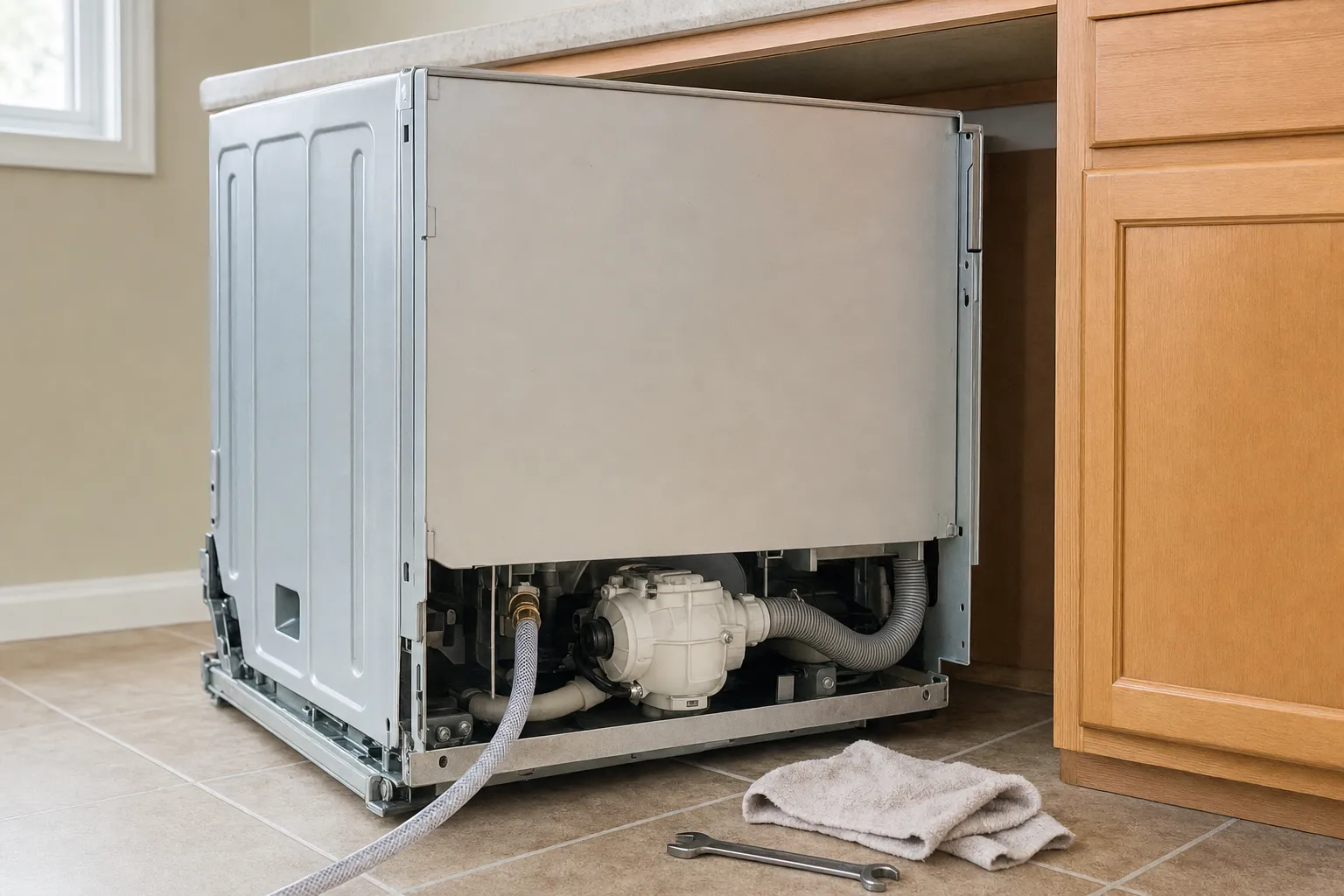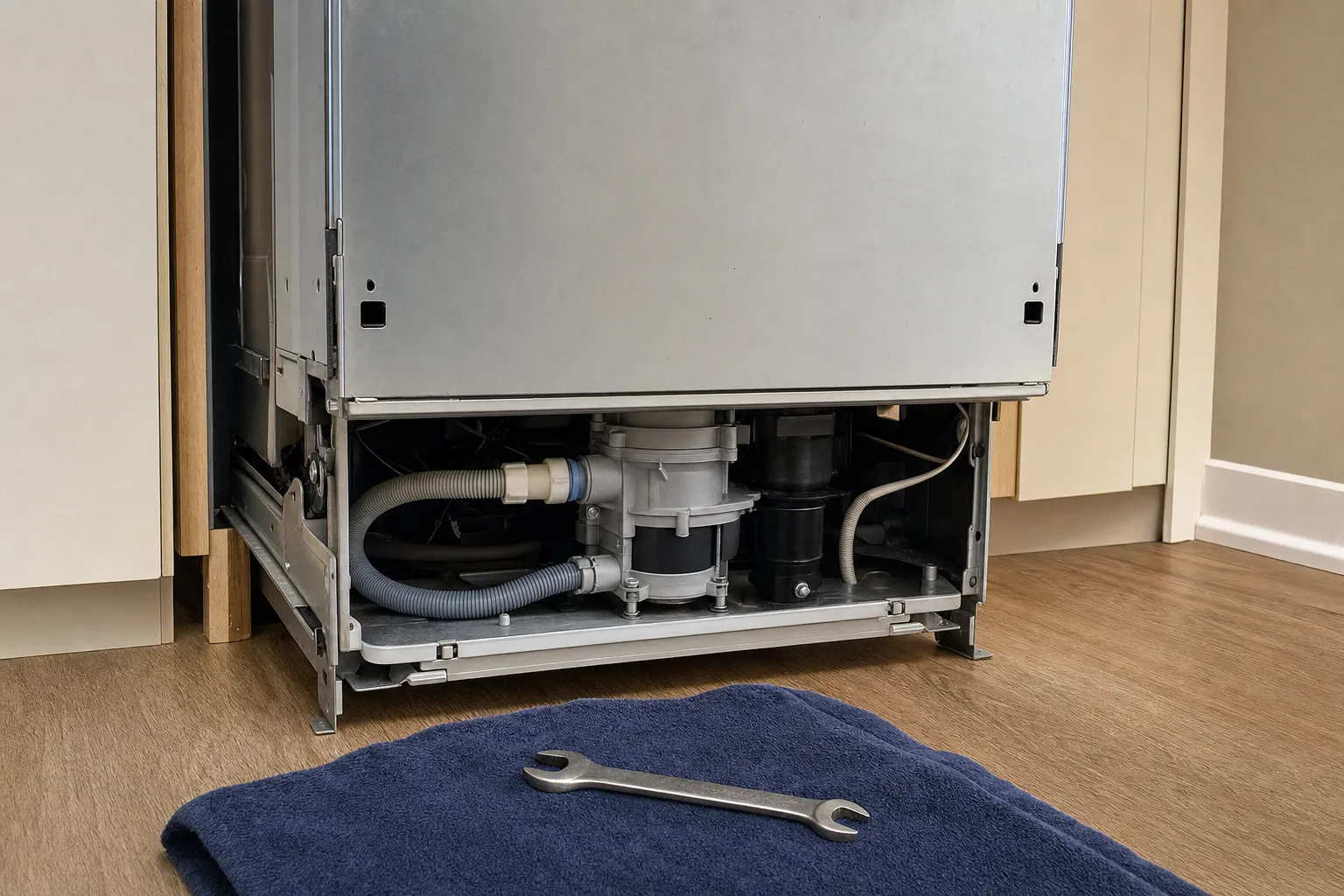
Standing water in the bottom of a Viking dishwasher is one of those faults where the expensive part gets blamed first and is almost never responsible. A drain pump that has genuinely failed is silent or grinding, and it fails suddenly. Most standing water arrives gradually, gets slowly worse over weeks, and traces back to a restriction somewhere between the sump and the drain — often to how the machine was plumbed in the first place.
First, know what normal looks like
A shallow film of water in the sump after a cycle is by design. It keeps the pump seal wet. If you can wipe the bottom of the tub with a cloth and it comes up damp rather than dripping, nothing is wrong.
What is not normal is water you can hear slosh when the door swings, water sitting above the filter plate, or water that appears clean at the end of a cycle but cloudy and smelling by the next morning. That is a machine that filled, washed and then failed to clear itself.
The filter and sump, which is where most of it is
Pull the lower rack and lift out the cylindrical filter. On Viking dishwashers it twists free by hand, and underneath it is a coarse screen over the sump.
Look for the things that do not break down: a fruit sticker, a strip of foil tape, a shard of glass, a chicken bone, the corner of a produce bag. Any one of them across the sump inlet halves the flow the pump can move, and a pump moving half the water it should looks exactly like a pump that is dying.
While the filter is out, reach into the sump with a gloved hand and feel around the impeller housing. Grit that has settled there over a couple of years forms a paste that stiffens the impeller. Rinse the filter under a hot tap, brush the screen with a soft brush, and put it back seated properly — a filter that is not locked down lets the next round of debris straight past into the pump.
The drain line, the air gap and the disposer
If the filter is clean and the water is still there, the restriction is downstream and you are now looking at the installation rather than the appliance.
There are four places it hides, and they are worth checking in this order because that is roughly how often each one is at fault:
- The high loop. The drain hose must rise to just under the countertop before it drops to the disposer or standpipe. Without that loop, sink water siphons back into the tub. In Kirkland condos and townhouses the hose is frequently clipped low behind a cabinet panel because there was no room to route it properly.
- The air gap. If there is a chrome cylinder on the sink deck, take the cap off. They silt up with food soil and are simple to clear, and a blocked one stops drainage dead.
- The disposer knockout. On a new disposer fitted after the dishwasher, the plug in the dishwasher inlet has to be knocked out and removed. If it was left in — or knocked in and never fished out — the dishwasher cannot drain at all. This is the most common cause we see on units under two years old.
- A kinked or crushed hose. Behind the machine, usually where it was pushed back into the cabinet after a previous repair.
What the noises are telling you
Stand next to the machine and start a drain cycle with the door catch held or the cycle selected fresh. You are listening for the pump.
A steady hum with no water movement usually means the impeller is jammed or the line beyond it is blocked. A grinding rattle means something hard is in the impeller housing. A pump that runs, changes note, then stops early points at the control board cutting the cycle short because it thinks the tub has emptied, and that in turn points at the float or the level sensor rather than the pump. No sound at all from the pump — with everything else on the machine working — is the one case where the pump or its wiring genuinely is the first suspect.
Why it usually is not the pump
Drain pumps on these machines are simple and they are not fragile. When one does fail it is normally because it has been running against a restriction for months, which is another way of saying that replacing it without finding the restriction buys you the same fault again next year.
There is also a cost argument. A blocked air gap is a ten-minute fix. A missing disposer knockout is a five-minute fix. A pump is a part, a labour charge and a tub that has to be drained by hand first. Working from cheapest and most likely towards most expensive and least likely is not caution — it is just the order the odds are in.
When to book the call
Book it if the filter and the visible drain path are clear and the water is still there; if you can hear the pump grinding; if the machine stops mid-cycle and resets itself; or if water is appearing under the kickplate as well as in the tub, which is a leak rather than a drainage fault and should not be left.
Have the model and serial number ready — on a Viking dishwasher it is on the edge of the tub, visible with the door open — and mention whether a disposer or garbage disposal was fitted at any point after the dishwasher. That one detail regularly tells us what the fault is before we arrive.
Asked after reading this
Is a small puddle in the sump normal?
Yes. Viking dishwashers are designed to retain a shallow amount of water in the sump to keep the pump seal from drying out. A film you can barely cover with a fingertip is normal; standing water you could scoop with a cup is not.
Will running the disposer clear it?
It can, if the blockage is in the disposer inlet or the branch to it. Run the disposer with cold water for thirty seconds and start a drain cycle. If that clears it once but the water returns within a week, the disposer was a symptom rather than the cause.
Can I bail it out and keep using it?
You can, but standing water in a warm tub turns sour quickly and the food soil that caused it is still in the machine. Bailing it out is a way to buy a few days, not a repair.